
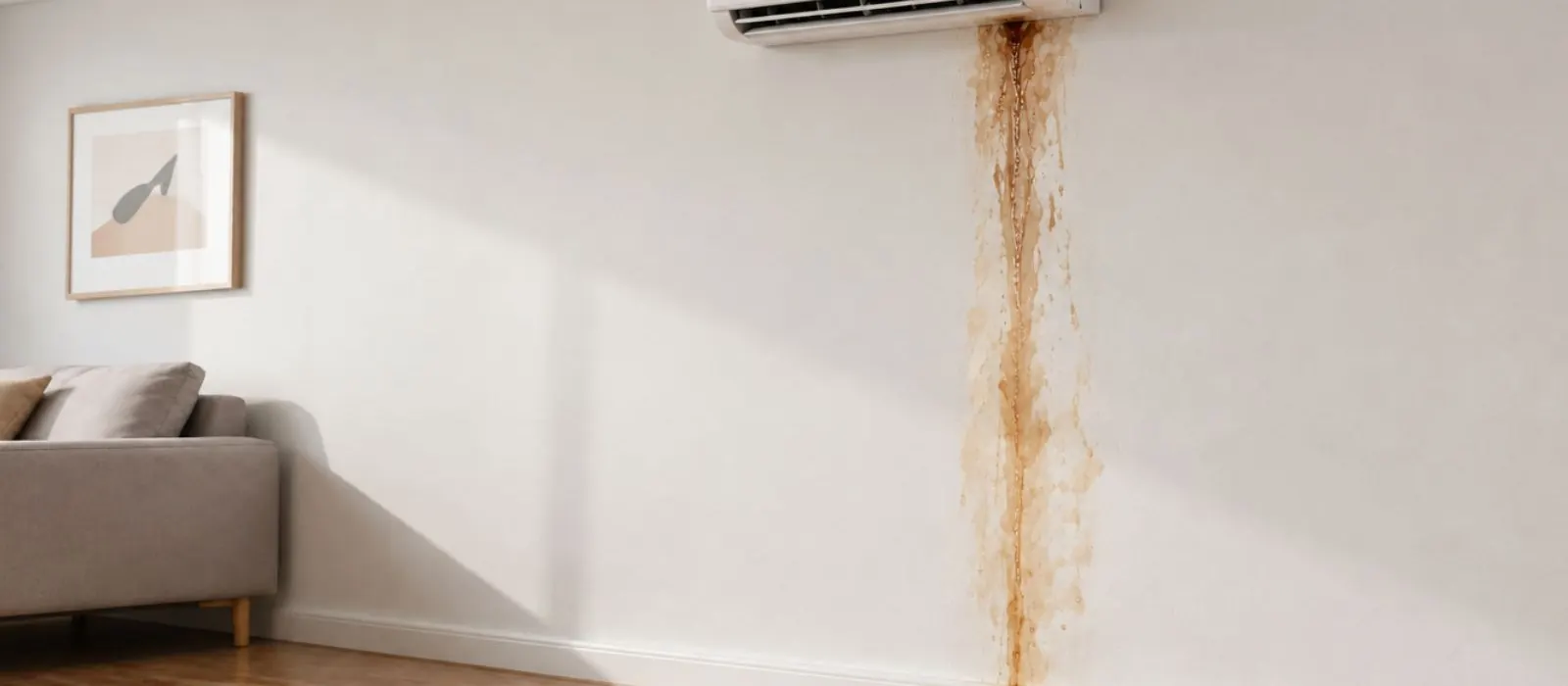
Air conditioners remove moisture as well as heat, and that moisture has to go somewhere. When the drain path clogs, the water backs into the drain pan, overflows and soaks the ceiling, closet or wall near the unit. In Apple Valley, where cooling runs for much of the year, AC leaks are one of the more common causes of ceiling damage. Call (760) 769-1159 if one has already soaked a ceiling.
Why AC leaks are common in the High Desert
The Town of Apple Valley community profile puts summer temperatures up to 110 degrees and lists about 350 sunny days a year. Cooling equipment runs hard and long in that climate. A system that runs most of the day can produce a lot of condensate, and the drain line that carries it away has to stay clear the whole time.
Dust is the other factor. Desert air carries fine particles that coat evaporator coils and clog filters. A dirty filter restricts airflow and can freeze the coil, and when the ice melts it overwhelms the drain pan. Lines also clog with algae and sludge, especially where the line runs through a hot attic.
The EPA guide to mold and moisture tells homeowners to keep air conditioning drip pans clean and drain lines unobstructed and flowing. Attic air handlers often sit above a hallway or closet ceiling, which is why a small clog can turn into a stained ceiling in one afternoon. Ductless wall units can leak down the wall instead.
Ductless mini-split and central systems leak differently. A central air handler in an attic overflows its pan and drips through a ceiling. A mini-split can drain behind the wall or down it, which hides the damage longer. A system that sat idle over the cool months can clog its line with sludge before the first hot week arrives.
Signs your air conditioner is leaking
| What you notice | What it usually means |
|---|---|
| A ceiling stain near a hallway or closet that grows on hot days | A clogged condensate line or overflowing drain pan above |
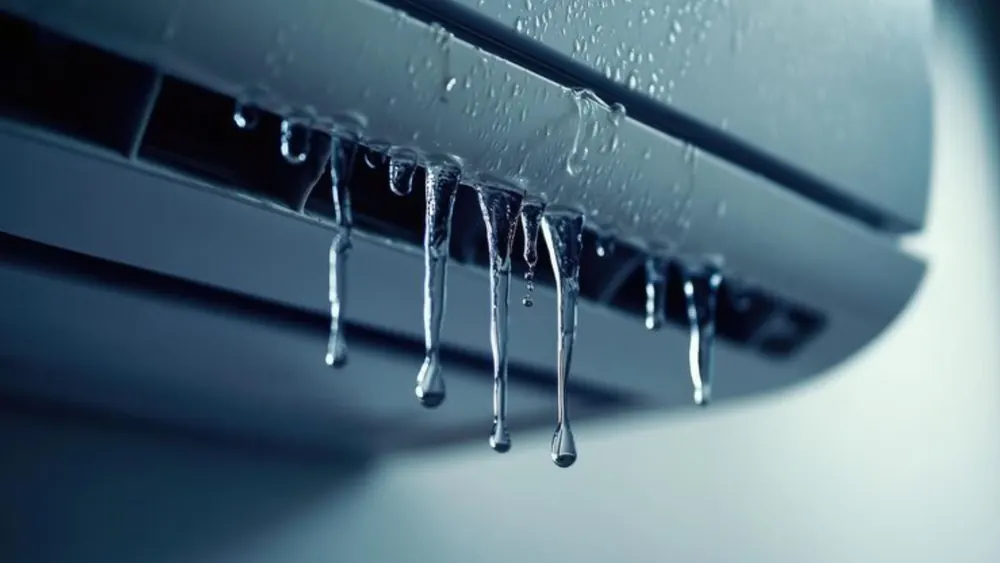
| Water dripping from the vent register | Condensation or a frozen coil melting inside the duct |
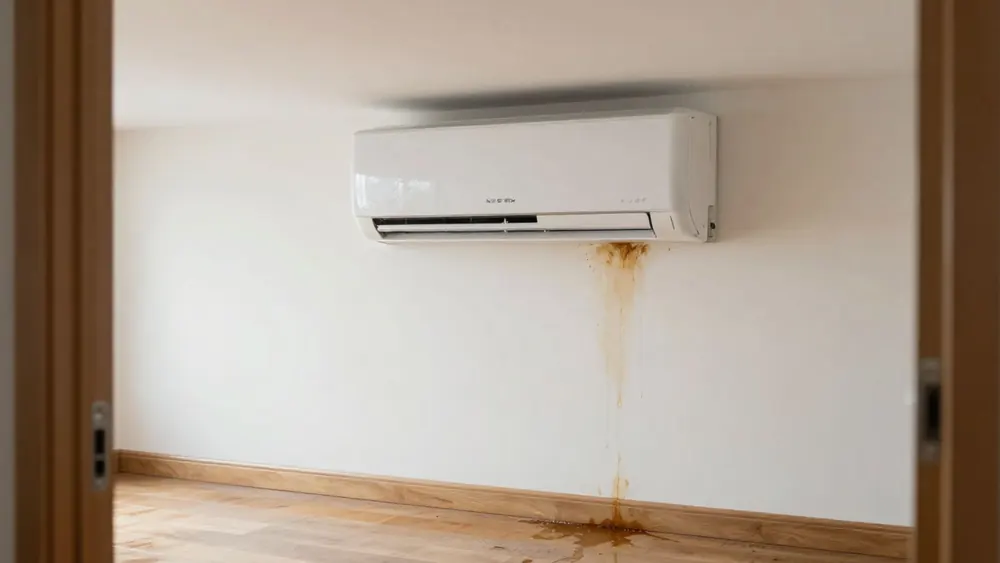
| A wet streak on the wall below a wall-mounted unit | The drain line or tray is blocked or tilted the wrong way |
| A musty smell near the air handler | Moisture and possible mold growth in the closet or attic |
| Ice on the indoor coil or refrigerant line | Airflow or refrigerant problems that will cause a leak when it thaws |
First-hour safety steps for an AC leak
Turn the system off
Switch the thermostat to off so the unit stops making condensate. If water is dripping from a light fixture or a fan, turn off that breaker if the panel is dry. Do not stand under a bulging ceiling.
- Turn the system off at the thermostat and, if you can reach it safely, at the air handler switch.
- Catch the water with buckets and towels below the leak.
- Check the drain line outlet if you know where it ends and look for a drip or a clog.
- Photograph the stain, the unit and the pan if you can see it.
- Call an HVAC technician for the cause and call us for the wet building materials. The California Department of Insurance advises keeping a log of calls.
Ceiling soaked by the AC?
Turn it off and call (760) 769-1159. The line is open 24/7.
How we handle an AC leak loss
We use moisture meters and a thermal camera to find how far the water spread, since it often travels along the ceiling joists before it shows. Wet insulation is removed from the area, and drywall is cut only where it is soaked or sagging. The closet floor and walls next to the unit are checked as well.
Drying equipment is placed after the wet material is removed. Air movers and LGR dehumidifiers bring the cavity down to the dry standard in ANSI/IICRC S500, which we use as the reference for water damage restoration. HVAC repairs themselves are done by an HVAC technician, not by us.
Once drying is done, water damage repair covers the ceiling and wall rebuild. For wider spread, see water mitigation.
What changes the cost of an AC leak repair
- How long the drain was blocked before the leak was found
- Whether the water came through the ceiling, the wall or both
- The size of the wet area and the type of insulation involved
- Ceiling texture and height, which change repair work
- Whether mold growth is visible and needs a separate inspection
- The equipment days needed to dry the cavity
Insurance and AC leaks
Policies often treat a sudden drain failure that damages the ceiling as covered water damage and a slow leak that has gone on for months as maintenance. Photos of the stain, a note of when it started and the HVAC technician report help the adjuster. The cost of fixing the HVAC unit itself is not normally part of the claim.
Your insurer decides coverage. We do not approve claims.
AC prevention and mistakes to avoid
- Change filters on a schedule, and more often in dusty seasons
- Have the condensate line flushed during the spring tune-up
- Install a float switch that shuts the system off when the pan fills
- Do not keep running a system that is dripping
- Do not paint a ceiling stain before the source is fixed
- Do not ignore a musty smell near the air handler
AC leak help across the High Desert
Crews work across 92307 and 92308 and in Victorville, Hesperia and Adelanto. Many leaks start in the first heat wave of the year, when systems restart after months of rest.
Frequently asked questions
Is emergency AC leak water damage repair available in Apple Valley?
Yes. Dispatch is open 24 hours a day, every day. A crew is sent the same day when one is available, and the dispatcher explains what to shut off. We do not promise an arrival time.
Do you fix the air conditioner?
No. An HVAC technician fixes the unit and clears the drain. We remove the water, dry the ceiling and walls and clean up.
Can an AC leak cause mold?
It can. The EPA says to dry water-damaged areas within 24 to 48 hours, and a leak that ran through insulation can hold moisture longer than that.
Is it safe to keep the AC running in a heat wave?
Not if it is dripping. Running a system with a blocked line adds water to the damage. Turn it off and call a technician first.
Does insurance cover AC leak damage?
Sudden drain failures are often covered for the resulting water damage, and long-running leaks often are not. Your insurer decides.